
October 6th, 2026
The workshop will be held physically in Bari, Italy.
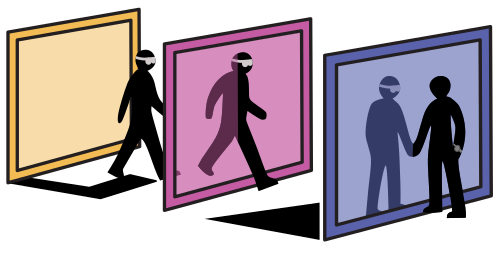
The XRTransitions ISMAR workshop aims to explore the multiple dimensions of the transitions between collaborative situations in extended reality. We will first examine whether transitions in single-user cross-reality systems apply to collaborative situations or need to be adapted for them. Then, other dimensions specific to collaborative situations will be explored, going beyond what has already been studied in single-user cross-reality systems. These include control over the transition—who initiates it, who executes it, and who stops it—as well as the awareness of other collaborators regarding transitions performed by a user.
Rationale: The number of collaborative systems in extended reality scenarios has considerably increased these last years, using shared spaces, tasks or objects that blur the boundaries between physical and digital life. Nowadays, collaborative XR environments have many applications, for example in the fields of education, training, industrial manufacturing, design, architecture, and urban planning. These applications define varied, often dynamic, collaborative situations. Multiple dimensions of collaborative situations have been explored depending on the number of users involved, the nature of the tasks to be performed, the manipulated objects, and the characteristics of the environment. In the meanwhile, collaborative XR environments often require users to adapt to changing tasks, roles, spatial arrangements, interaction modalities, and levels of immersion. Designing efficient transitions between these collaborative situations is therefore essential for maintaining users’ awareness, coordination, communication, and overall engagement. However, the definition of seamless and efficient transitions between collaborative situations still remains underexplored. Indeed, while transitions and transitional interfaces are key concepts in the study of single-user cross-reality systems (see the scoping survey on Cross-reality Systems by Auda et al. https://doi.org/10.1145/3616536), the design of transitions within collaborative situations has not been studied in a systematic manner. A better understanding of such transitions could improve the continuity, usability, and effectiveness of collaborative XR experiences across a wide range of applications.
This workshop aims to bring together researchers and practitioners interested in transitions in single-user or collaborative cross-reality systems, fostering discussions on interaction techniques, user experience, system design, and applications that enable efficient transitions along the continuum from physical to virtual environments. Topics of interest include:
All deadlines are 23:59 AoE.
We welcome paper submissions of 4–6 pages, excluding references and appendices. Examples of submissions include:
Submissions should be anonymous and follow the VGTC conference template, see https://tc.computer.org/vgtc/publications/conference/. Papers must be submitted through the EasyChair system at https://easychair.org/conferences/?conf=xrtransitions26. Each submission will be reviewed by at least two program committee members following a single-blind review process. Accepted papers will be published in the IEEE Digital Library within the IEEE ISMAR Abstract and Workshop proceedings. At least one author of each accepted paper is required to register, attend, and present their work at XRTransitions.
We also allow submissions without publication. For these, authors may submit a 2-page abstract, following the same template as the papers.